


Artificial intelligence isn’t just changing tasks and processes. It’s challenging the very structure of our companies – and forcing CEOs to have an uncomfortable discussion about hierarchy, accountability, and the future role of leadership.
In many companies, leadership in the age of AI is still approached from a surprisingly operational perspective. Which processes can be automated? Where can employees become more productive? Which applications should be implemented, and how quickly can they yield efficiency gains? These questions are important, but they don’t go far enough. Because the more powerful artificial intelligence becomes, the less it’s just about getting existing work done faster. It’s increasingly about whether companies should even continue to organize work the way they have in the past. For CEOs, this raises a question that’s far more uncomfortable than deciding on the next AI system: How many levels of management does a company still need if knowledge, coordination, and decision support are no longer tied to hierarchies?
Why have companies needed multiple levels of management up until now?
Today’s organizational structures emerged under conditions that remained largely stable for decades. Companies had to collect, analyze, and synthesize information. Knowledge was scarce and often tied to specific functions or individuals. Decisions required coordination, oversight, and approval.
Consequently, several layers of management emerged between employees and senior leadership. These layers relayed information upward, communicated decisions downward, and coordinated, prioritized, and monitored activities in between. This system was by no means inefficient. It was a rational response to the technological and organizational possibilities of its time. But it is precisely these conditions that are now changing.
How AI Is Changing Traditional Management Tasks
Artificial intelligence can organize information in seconds, analyze large amounts of data, develop scenarios, and prepare decisions. Employees gain access to knowledge and analytical capabilities that previously required experts or entire departments. AI agents are beginning not only to support tasks but also to independently coordinate and execute individual work steps. This fundamentally changes the question of productivity.
If, in the future, an employee can accomplish significantly more than before with the help of AI, companies must do more than just talk about efficiency. They must discuss team sizes, areas of responsibility, decision-making processes, and, ultimately, their organizational architecture.
What I’ve Observed in the U.S.
During my trips to the U.S., I’ve noticed that this very discussion is increasingly shifting. The more interesting conversations no longer start with the question of which AI tool to use. They begin where the consequences of the technology become apparent.
- How does an organization change when small teams suddenly have capabilities that were once reserved for large units?
- What management tasks remain necessary when information no longer needs to be aggregated across multiple levels?
- How does the span of control change when analysis, administration, and coordination are increasingly supported by technology?
- And what happens to a hierarchy whose original function can be partially taken over by intelligent systems?
What This Means for German Companies
This discussion is particularly important for German companies. We tend to integrate new technologies into existing structures first. Digitizing a process often seems more obvious than asking whether we still need it at all. Companies automate reporting without questioning why it has to pass through multiple levels of the hierarchy. Managers receive new AI tools, while their responsibilities remain largely unchanged. This leads to efficiency gains, but not necessarily to transformation.
A company does not become an AI-first organization simply because its existing organization now uses AI.
Optimize or redesign? The crucial AI question
The key difference lies between optimization and redesign. Optimization asks how an existing organization can become more productive with AI. Redesign asks how we would build that organization today if we already knew what possibilities artificial intelligence offers. The answers to these two questions can be completely different.
A company with six levels of management can use AI to make each individual level more efficient. However, it might also realize that two of these levels exist primarily to consolidate information, prepare reports, coordinate efforts, and relay decisions. If AI takes over a significant portion of these tasks in the future, what was once a question of productivity suddenly becomes a question of structure.
Do companies need fewer management levels in the age of AI?
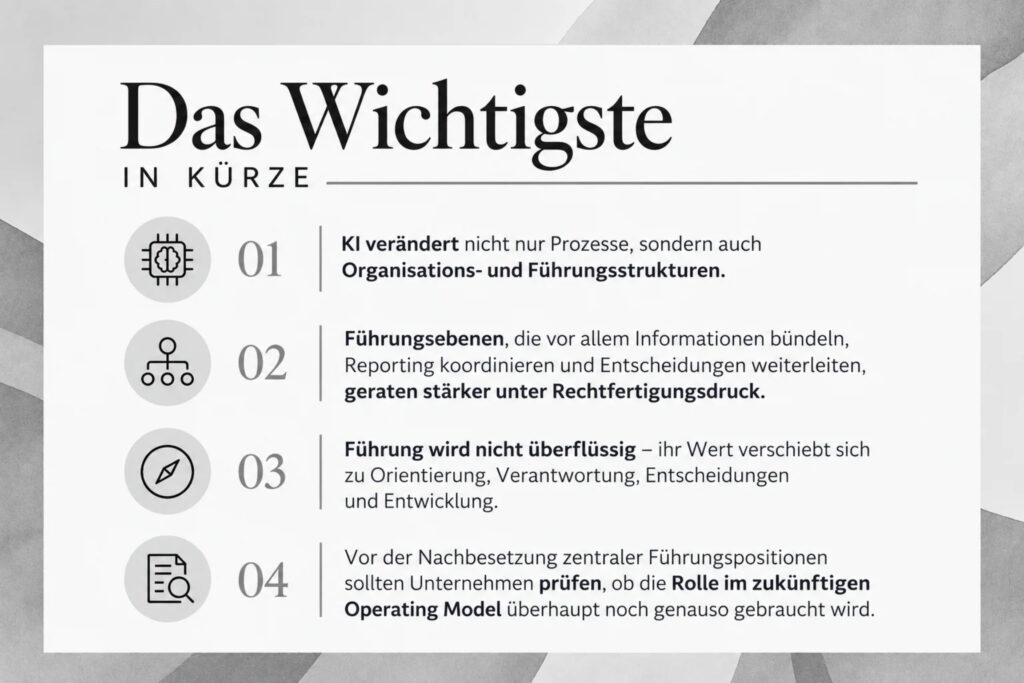
This explicitly does not mean that middle management is on the verge of disappearing or that companies should become as flat as possible. Such predictions underestimate the true significance of leadership. People need guidance. Leaders must take responsibility, resolve conflicts, set priorities, and develop employees. Especially in a world where companies are changing more rapidly, good leadership may become even more important. But its legitimacy is changing.
A leader whose primary contribution consists of passing on information, collecting status reports, and coordinating decisions across multiple levels will find it harder to justify their value in the future than a leader who facilitates better decisions, provides direction, takes responsibility, and connects people and artificial intelligence into a high-performing system.
How AI Is Changing the Role of Leadership
This is precisely where one of the central challenges of AI-Augmented Leadership lies. Artificial intelligence does not replace leadership. Rather, it forces companies to define more precisely where leadership actually creates value. For decades, many organizations have equated leadership with hierarchy. Those who took on more responsibility led more people, received larger budgets, and moved up the organizational chart. In an AI-driven organization, this logic could change. In the future, leadership will depend less on how many people someone controls and more on their responsibility for decisions, results, and change.
This has significant implications for CEOs. After all, organizational structures are not just abstract boxes on an organizational chart. Behind every level lie costs, career paths, status, decision-making authority, and power. Introducing a new AI assistant is therefore much easier than asking whether certain leadership structures are still necessary. This could be one of the reasons why many companies initially focus on productivity gains. Productivity leaves the existing system largely untouched.
Transformation, on the other hand, calls the system itself into question. Yet in the long run, this is precisely where AI’s greatest economic leverage might lie. When companies merely perform the same tasks more efficiently, they realize only part of the potential. If, on the other hand, they begin to recombine tasks, teams, decision-making processes, and responsibilities, their operating model changes. The introduction of a technology becomes a redesign of the company. Senior management and the executive board must take responsibility for this transformation rather than delegating it to an AI department.
Why CEOs Should Reexamine Leadership Roles
This also directly affects the filling of leadership positions. In many companies, the succession process still follows a familiar pattern: A leader leaves the company, the position becomes vacant, the company updates the existing job description, and then searches for the most suitable successor. In a stable organization, this approach makes sense.
However, during a period of fundamental change, this approach can lock a structure in place for years without companies first asking whether they still need it.
Before companies fill a key leadership position, they should therefore ask themselves a strategic question: Would we create this position exactly the same way again today? Only then should they discuss who is the right person for the job.
- How is AI changing the responsibilities of this role?
- What responsibilities remain with humans?
- Which tasks can be automated or prepared by intelligent systems?
- How big will the team need to be in the future?
- What decisions can it make on its own?
- What specific value must a leader create in this new context?
How AI Is Changing Executive Search
This is also changing the field of executive search. The future cannot consist simply of using AI to identify candidates for existing job profiles more quickly. That would be a technological improvement to an outdated process. The greater challenge lies in first understanding the future leadership role and only then searching for the right person.
That’s exactly where AI-Leadership Search begins for me: not with the search for candidates, but with the question of what kind of leadership a future organization actually needs.
This fundamentally changes the order of priorities. The starting point is no longer automatically a vacant position, but rather the company’s strategic development. This determines the future operating model, the roles of people and AI, the necessary decision-making and leadership structures, and, ultimately, the question of who can take on these responsibilities. For CEOs, this is more than just a new recruiting method. It is part of the organizational strategy.
Conclusion: How much organization does a company still need in the age of AI?
Perhaps this is one of the greatest opportunities presented by the current AI transformation. Companies can do more than just automate individual tasks; they have the opportunity to reexamine structures that have evolved over decades and eventually came to be taken for granted. Not every hierarchy is superfluous, and not every leadership position needs to be changed. Nor does every company automatically have to become flatter. But in the future, every level should be able to provide a convincing answer to a simple question: What value does it create in an organization where knowledge, analysis, and coordination are increasingly supported by artificial intelligence?
Companies that find a solution to this early on will do more than just implement AI. They will adapt their organizations to take advantage of these new opportunities. The others run the risk of using one of the most powerful technologies of our time to make structures – designed for a different era – more efficient.
For CEOs, therefore, the key question is not just how much work artificial intelligence will be able to take over in the future. The more important question is how much organization we will still need once it does.
FAQ: Leadership in the Age of AI
Will AI replace middle management?
Not automatically. AI primarily transforms tasks related to information processing, analysis, reporting, and coordination. Leadership remains important in areas where guidance, accountability, conflict resolution, prioritization, and employee development are required.
Will AI Make Companies More Flat?
Not necessarily. What matters is not the number of levels, but the specific value that each management level creates in an organization where knowledge, analysis, and coordination are increasingly supported by AI.
How Is AI Changing Executive Search?
In the future, companies should first define the future leadership role, the operating model, and the roles of people and AI – and only then look for the person who can take on that responsibility.
by Frank Rechsteiner