


AI is challenging an assumption that has underpinned our economy for decades: that a company can only grow by hiring more people.
Until now, growth meant more people
In recent decades, anyone who wanted to grow hired more people. Higher revenue meant more projects, and more projects meant more staff. With every step of growth, new layers of management were added, and the effort required for coordination increased accordingly.
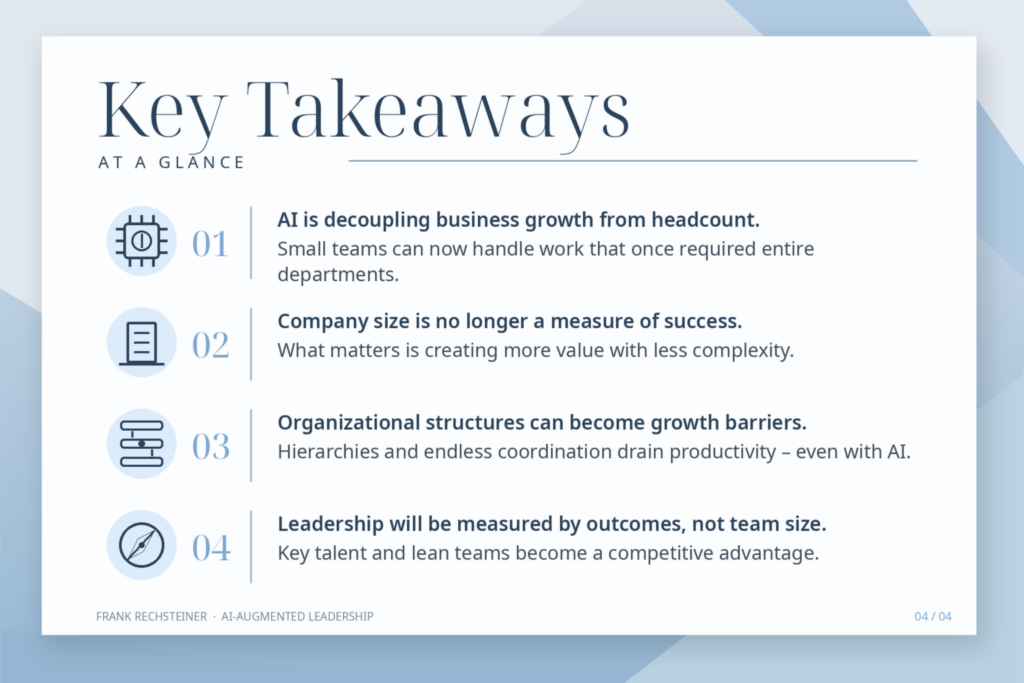
AI is beginning to overturn this assumption. Today, a small team can handle tasks that would have required an entire department five years ago. As a result, the size of a company says less and less about its performance. The implications for competition and leadership are surprisingly rarely discussed in the AI debate.
The Wrong Debate
Public debate focuses primarily on which jobs AI will make obsolete. For you as a CEO, another question is more important: How much more can your company achieve with the same employees?
Anyone who views AI as a cost-cutting measure remains trapped in the old way of thinking and simply does the same things more cheaply. It only gets exciting when you consider what your organization could accomplish with a multiple of its current output.
During my trips to the U.S., I’ve noticed in many conversations that people there hardly talk about automation anymore. They talk about growth. Small teams are building products and conquering markets at a pace that used to be reserved for large companies. This is by no means true for every industry. Nevertheless, the trend is clear: a company’s size and performance are moving in different directions.
Size as a status symbol has had its day
We still like to measure success by the number of employees. Anyone who has grown a company from 50 to 500 people is considered to have built something. Investors have long since started looking at revenue per capita. In many traditional companies, however, the workforce continues to grow along with the business, without anyone asking questions.
I consider this a thing of the past. The company that will be successful is the one that creates a lot of value with minimal complexity.
So the question of where AI saves costs doesn’t go far enough. Instead, ask yourself how you would structure your company if increased productivity no longer required additional staff. This question forces you to take a hard look at your entire organization—right down to the uncomfortable question of how much management you actually still need.
Efficiency Isn’t Enough
Most companies initially use AI to speed up existing processes. This yields measurable gains. It does not change the business model.
Here’s an example: At a management consulting firm, growth had previously depended on the number of consultants. Every new project required additional consultants, and with them, the project management and administrative apparatus grew. Eventually, another level of management was added.
When a consultant uses AI to complete research and analysis in a fraction of the time, the natural instinct is simply to give them more projects. It would be wiser to rethink the business model. Perhaps a small team will be able to take on projects in the future that were previously too large for it to handle. Perhaps margins will increase without raising prices.
The same applies to almost every business that thrives on knowledge. There, an old certainty is beginning to waver: that size automatically brings cost advantages.
Their closest competitor has 30 employees
That’s why I think chasing after individual AI applications is risky. Anyone who’s only looking for a five or ten percent increase in efficiency is overlooking the competition that’s currently emerging. In the future, your company with 100 employees will be competing against companies with 30 employees that, thanks to technology, deliver the same performance at a fraction of your costs.
Established companies have capital and customer relationships on their side. However, they also carry the burden of hierarchies and fixed costs that have built up over the years. A newcomer doesn’t have to recreate these structures. It starts out with a lean structure right from the beginning.
Ask yourself honestly: Is the size of your company still an advantage? Or are you managing structures that a new competitor wouldn’t even bother to build today?
On top of that, there’s an effect that many people overlook. Even if every single person becomes more productive, the company’s overall productivity doesn’t increase nearly as much. In large organizations, a lot of time is wasted on coordination meetings and reporting. The greatest benefit of AI might be that it prevents this friction from arising in the first place.
Leadership Is Being Re-Evaluated
Until now, success was measured by who was in charge of large departments with large budgets. That standard is losing its significance. In the future, what will count is how much a department accomplishes and how little effort it takes to do so.
If a division grows from 500 to 1,000 employees, someone should therefore ask why those 500 additional people were necessary.
Every new position costs more than just the salary. It ties up management time and creates obligations for years to come. If technology absorbs part of that growth, capital is freed up. You can invest it in new markets or in the few people who make the difference in your company.
It all comes down to just a few people
Those who achieve more with fewer people rely more heavily on each key person. AI makes some tasks obsolete while simultaneously increasing the value of outstanding individuals. This may sound paradoxical, but it follows a simple logic: In small teams, each individual has a greater impact on the outcome.
A strong leader can manage a much larger area with the help of AI. A top-notch salesperson can handle significantly more customers. This shifts the focus of the staffing question: The key is to find the few people who will make a difference at your company.
What This Means for You as CEO
In many companies, the discussion about AI stops at productivity. It needs to go further—all the way to the question of what your company should look like in five years. What structures would you not even consider building today? And what kind of people do you need when a few key positions can make such a big difference?
This is where AI Leadership Search comes in. For me, the term means more than just a faster search using AI tools. As what organizations are capable of doing changes, so too does what their leaders must be able to do.
In the future, a CEO’s most difficult task might be keeping an increasingly high-performing company small. This reverses a management logic that has held true for decades.
The question that matters
For a long time, we’ve defined growth by how much larger companies became. In the future, what will matter is how much a company achieves without becoming larger or more complex. Those who find an answer to this early on will transform their business model. This transformation will determine who comes out on top in the coming years.
That’s why the question you should be asking yourself today is:
What will become of your company when ten outstanding people will soon be able to accomplish what you needed a hundred people to do just yesterday?
by Frank Rechsteiner